Hospital operations intelligence.

A real-time command centre for hospital capacity — patient flow, bed coordination, discharge planning, transfers, cleaning, predictive AI, and a live 3D digital twin. It turns fragmented operational data into one source of truth. Pre-production

The operational layer above the hospital.

Hospitals lose capacity every day to invisible bottlenecks — beds that sit unturned, discharges that stall. KODA FLOW gives operations and executive teams real-time visibility, coordinated patient flow, and data-assisted decisions, integrating with existing systems without replacing them.

The platform

One platform, every operational surface.
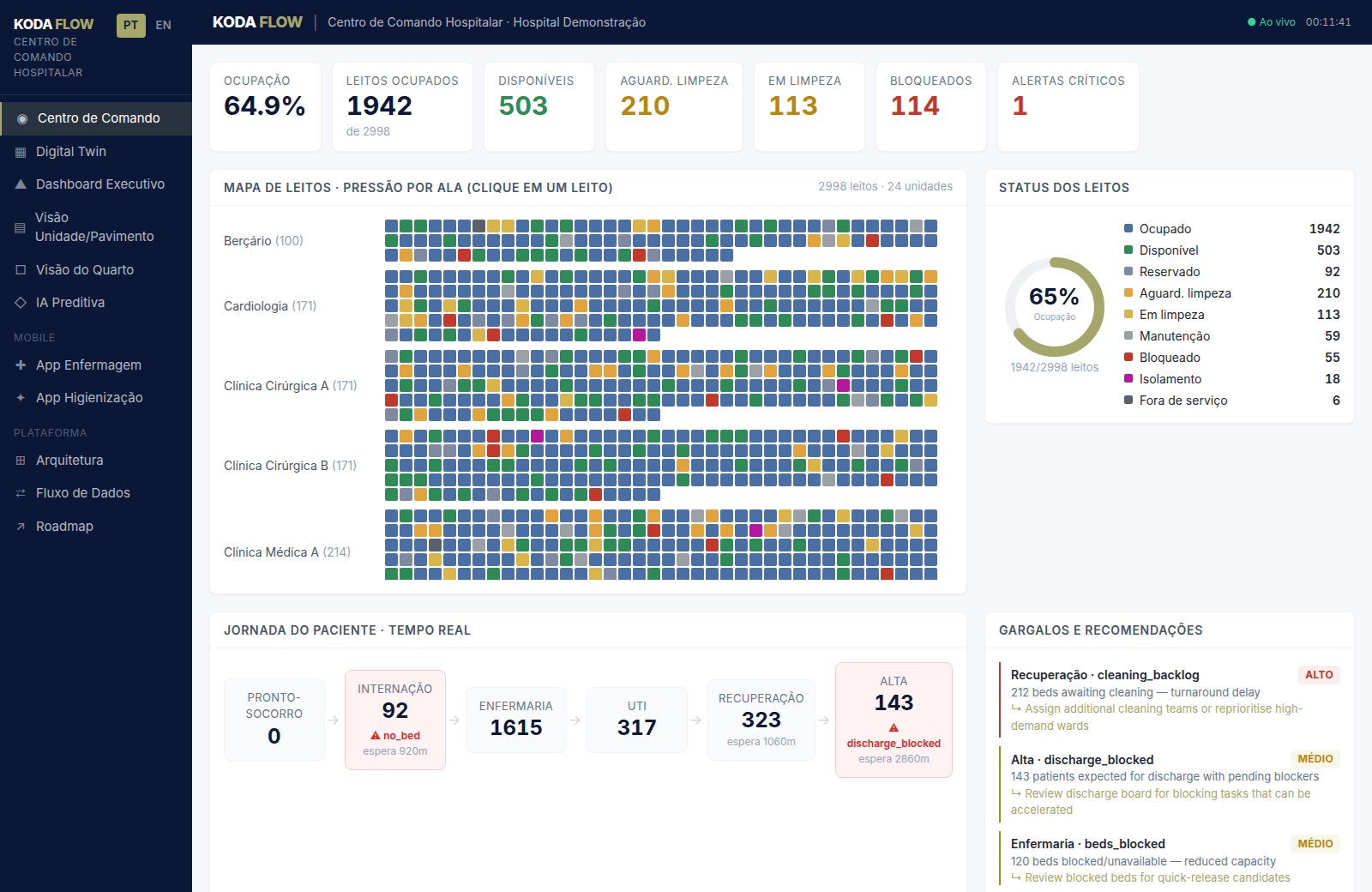
Command Centre — live occupancy, ward-pressure bed map, real-time patient journey, bottleneck recommendations.
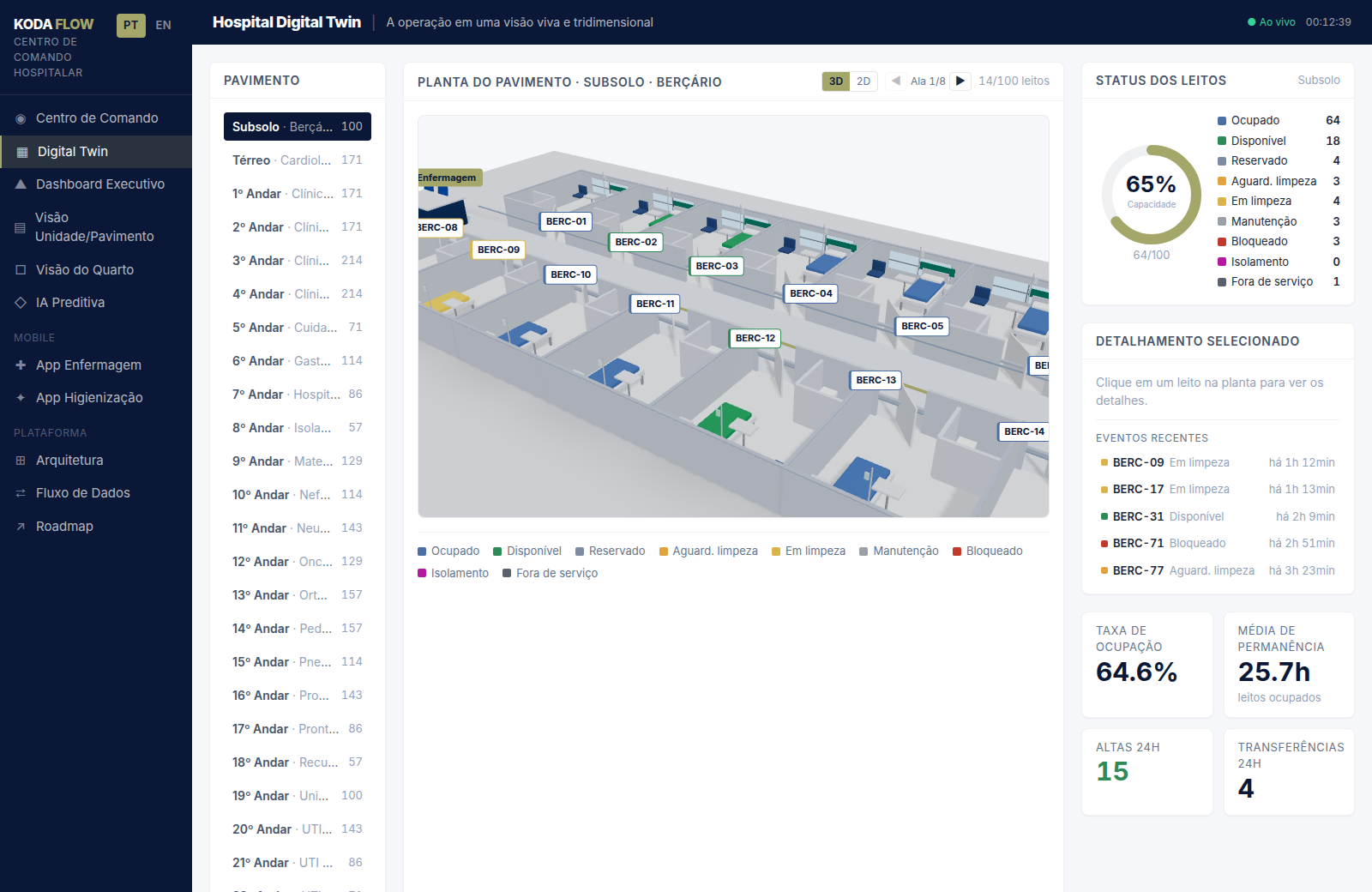
3D Digital Twin — a walkable architectural floor: rooms, walls, windows, beds positioned and colour-coded by live status.
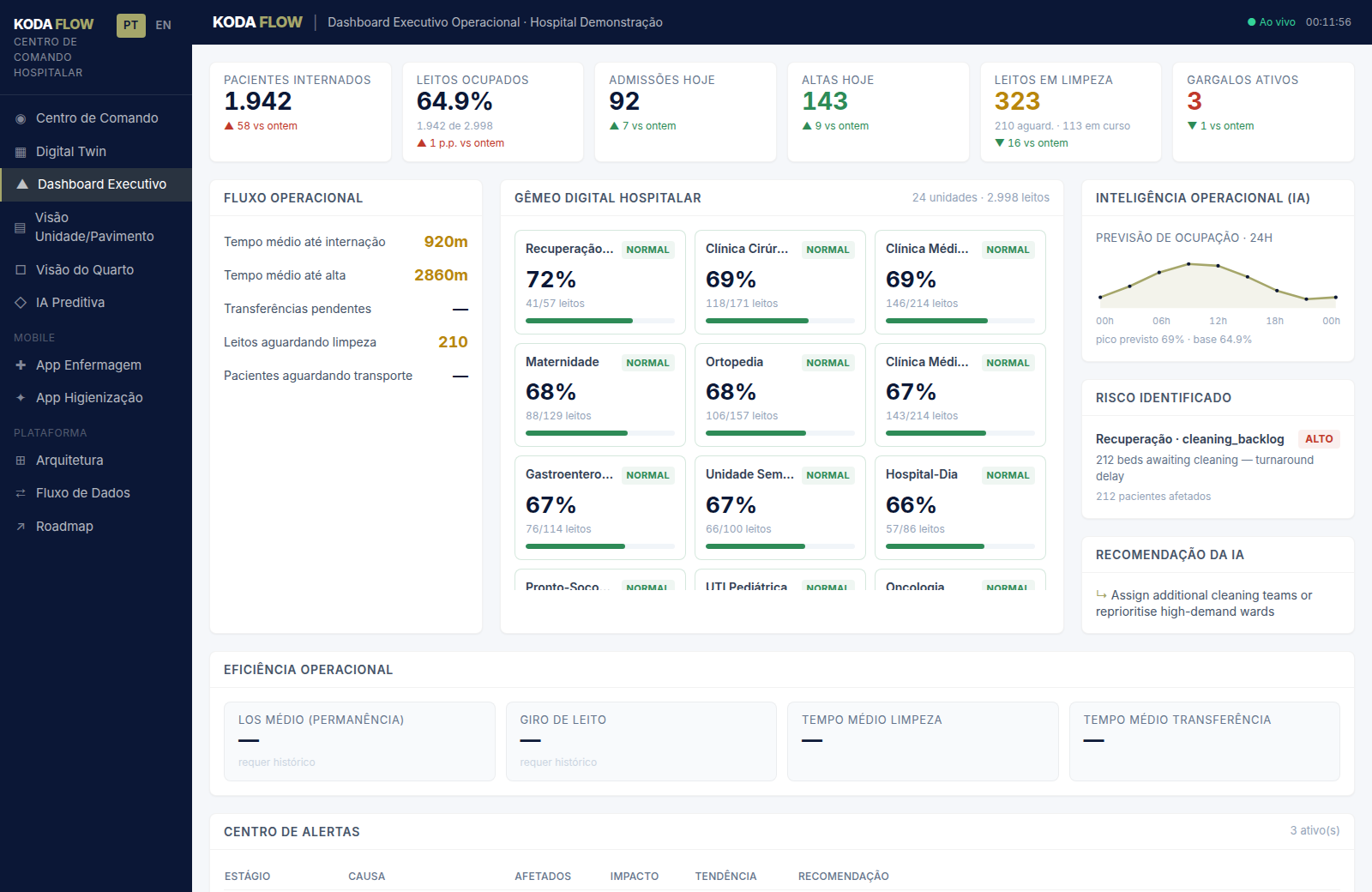
Executive Dashboard — operational KPIs, flow timing, AI risk and recommendations, efficiency metrics.
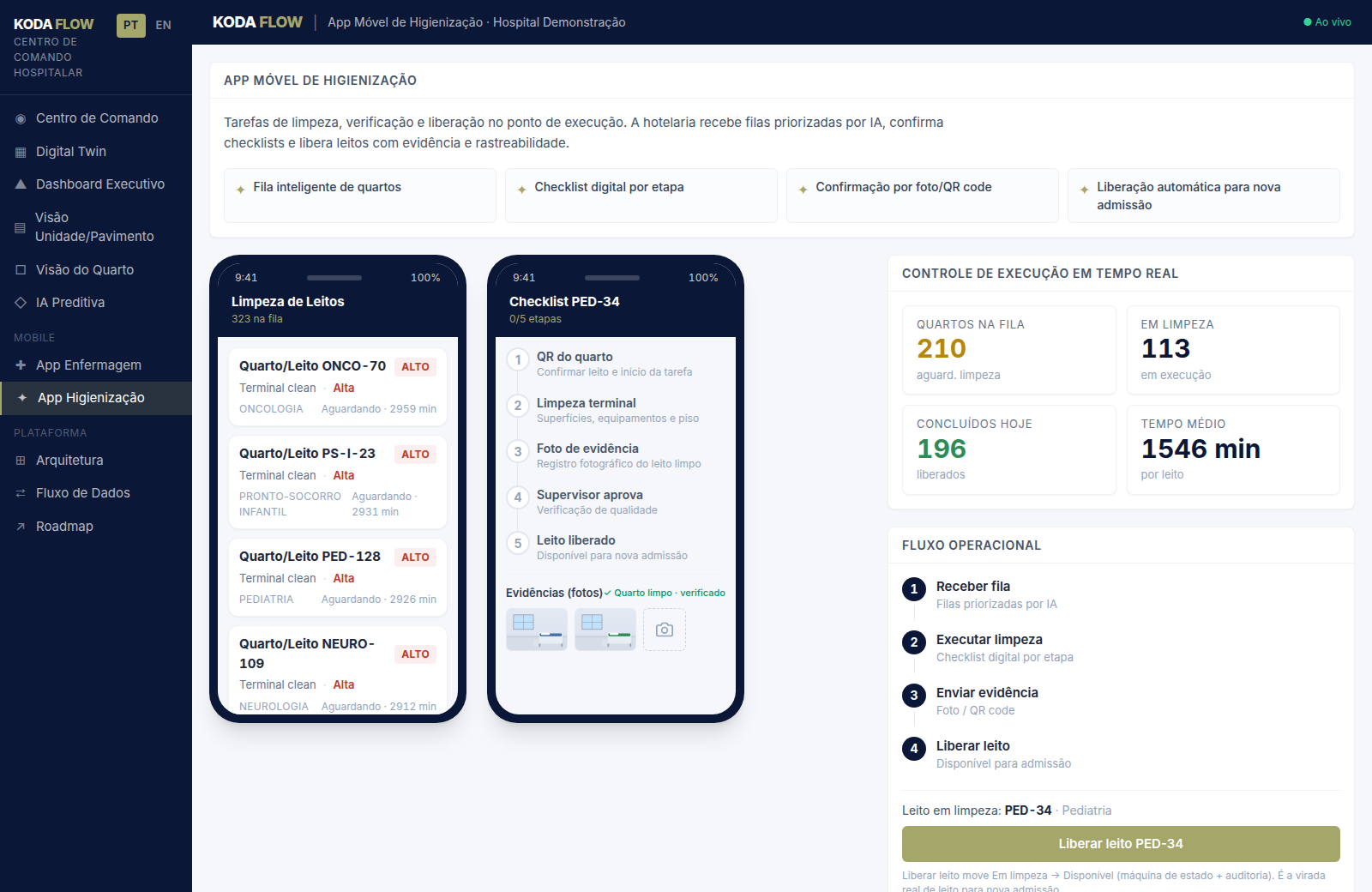
Housekeeping App — AI-prioritised cleaning queue, digital checklist with photo evidence, automatic bed release.

Screens shown with illustrative demonstration data. Bilingual (PT-BR · EN-US); a dark, trilingual variant is also available.

Above your systems

A vendor-neutral operational layer that sits on top of the EMR/HIS the hospital already runs. No rip-and-replace.

The AI recommends; humans decide

KODA FLOW forecasts, prioritises and recommends. Clinical teams stay responsible for every decision.

Real-time 3D digital twin

See the building, the floor, and the room — beds and equipment positioned in 3D, status live.

Built on KoLo

Persistent memory, auditability and governed agents — the continuity runtime beneath the platform.

The bottlenecks

Capacity is usually lost in four places.

Hospitals rarely lose capacity to a single dramatic failure. They lose it in small, repeated, individually reasonable delays that no one person can see end to end.

The unturned bedA patient has left, the bed is empty, and nobody downstream knows it yet. Capacity exists on paper and not in practice.
The stalled dischargeClinically ready, operationally blocked — waiting on transport, pharmacy, a signature or a bed elsewhere.
The invisible queueDemand that never reaches a system because it is held in a phone call, a whiteboard or somebody’s memory.
The late escalationPressure that was predictable hours earlier but only became visible once it was already an incident.

Operational surfaces

One system, five points of view.

A bed manager, a ward sister, a housekeeper and a chief operating officer need different views of the same truth — not four systems that disagree.

Command centreLive occupancy, ward pressure, patient journey and the bottleneck currently costing the most capacity.
Digital twinThe building as it actually is — floors, rooms, beds and equipment positioned in 3D and coloured by live status.
Executive viewFlow timing, operational KPIs and trend, aimed at the decisions taken weekly rather than hourly.
HousekeepingA prioritised cleaning queue with photo evidence and automatic bed release on completion.
Transfer and dischargeThe steps, owners and blockers on each pending move, visible to everyone who touches it.

Integration posture

Sit above the systems, not inside them.

Read from what existsThe EMR/HIS, ADT feeds, scheduling and housekeeping systems the hospital already runs.
Write back narrowlyStatus changes the hospital has explicitly authorised — never a silent write into the clinical record.
Reconcile, do not duplicateWhere two systems disagree, the disagreement is surfaced rather than resolved by overwriting one.
Degrade visiblyA feed that stops is shown as stopped. Stale data is marked stale rather than displayed as current.

The last one matters most in an operations room. A dashboard that cannot say when it last heard from a feed will eventually be trusted through an outage.

Status and claim boundary

What we are not claiming.

Pre-revenue and pre-deploymentThe platform is built. It is not running in a hospital today, and we do not claim otherwise.
No clinical claimKODA FLOW is an operational tool. It does not diagnose, triage or make clinical recommendations.
No regulatory clearanceNo medical-device clearance is held or claimed for this platform in any jurisdiction.
Illustrative dataEvery screen shown on this page uses demonstration data, not a real patient population.

See KODA FLOW on your operation.

We are pre-revenue and pre-deployment, and clear about it — the platform is built. Request a live walkthrough, or a controlled pilot scoped to your capacity, beds, and flow.

Request a live walkthrough